
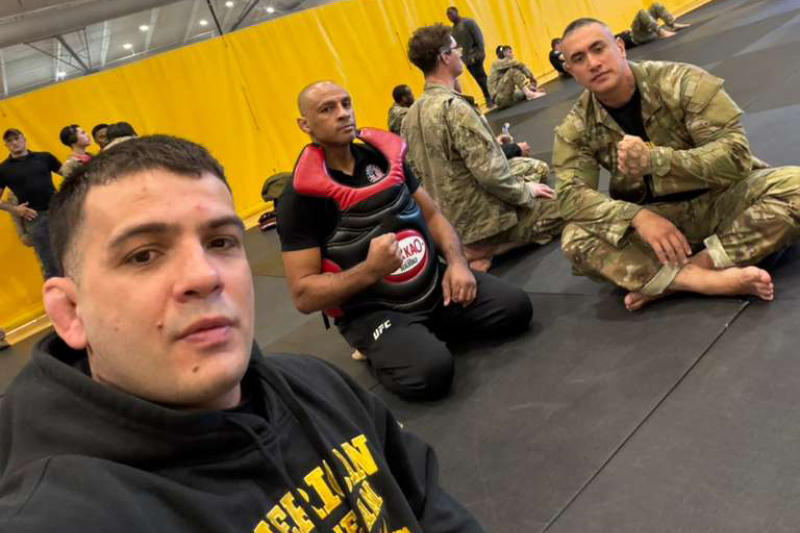
Daniel Hortegas, Roan Jucão and Luan Chileno backstage at the Lacerda Cup – Photo: personal archive
Daniel Hortegas’ participation in the Lacerda Cup, held in Fort Benning, United States, was more than just a competitive experience. Integrated into the routine of American Top Team and training under the leadership of Roan “Jucão” Carneiro at ATT Sandy Springs, the black belt lived a moment that, according to him, represents the deepest essence of Jiu-Jitsu.
“Jiu-Jitsu is a bridge that keeps expanding its reach. Realizing that decades of dedication to evolving as an athlete led me to this moment—where Jiu-Jitsu returns to its original practice in a martial sense, not purely as a sport—was very interesting,” Hortegas said. “Seeing the U.S. Army benefit from Jiu-Jitsu and, in some way, being part of that was extremely rewarding.”
With a solid career that includes IBJJF world titles, participation in ADCC, and MMA fights in Brazil and abroad, Hortegas sees his journey as directly connected to the environment that led him to this experience. His long-standing relationship with American Top Team and his partnership with Jucão were key factors.
“It was through those results and the dedication it took to achieve them that I received the invitation to return to the United States and train at American Top Team, a team I’ve been part of since 2005. One thing connects to another. Being here training with my longtime friend Jucão at ATT Sandy Springs led to the invitation to participate and help Luan at the Lacerda Cup,” he explained.
According to the black belt, being immersed in a high-level environment like the American team reinforces the importance of staying active and constantly evolving—not only as an athlete, but as someone capable of impacting others through martial arts.
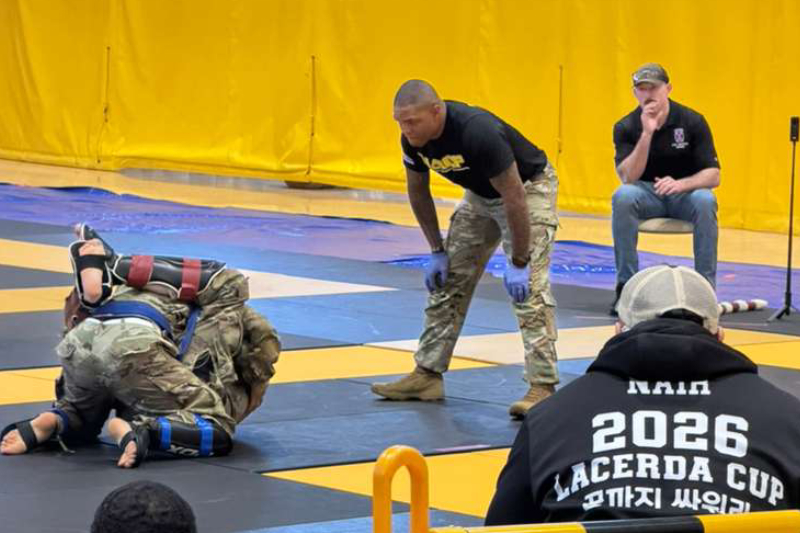
The Lacerda Cup was held in Fort Benning – Photo: press release
“Being there was a strong confirmation of how essential it is to remain active and engaged in continuous practice and evolution, because our contribution as athletes and martial artists to society goes beyond sporting and entertainment events,” he stated.
The experience gained even more meaning as he shared the environment with athletes like Luan Chileno, a Brazilian who built his career in Muay Thai before joining the U.S. Army. For Hortegas, this type of path highlights the impact of martial arts on personal development and the creation of new opportunities.
“Luan showed that sport prepares you for new journeys. High-level performance gives you the ability to handle any level of challenge and overcome difficulties in pursuit of something greater. And when we look at the story of Pedro Lacerda, who the event is named after, we see a legacy that goes beyond life itself. That’s incredible,” he said.
Over the years, Hortegas has come to see more clearly the role of Jiu-Jitsu as a tool for transformation—something that, according to him, has always been present, but now carries even greater meaning both on and off the mats.
“It has always gone hand in hand. Even with a competitive focus, we’re constantly dealing with people. The ability to adapt, overcome difficulties, and persist becomes an opportunity to serve—whether as emotional support or as a reference for those who need a path forward,” he analyzed.
Outside the mats, this philosophy also reflects in his personal life. “There’s an invisible force that is the true difference-maker for those who practice Jiu-Jitsu long term. The benefits last a lifetime. Today, as a father, I see my children benefiting from these values and from the physical and psychological skills the sport provides,” he concluded.
Ver essa foto no Instagram