
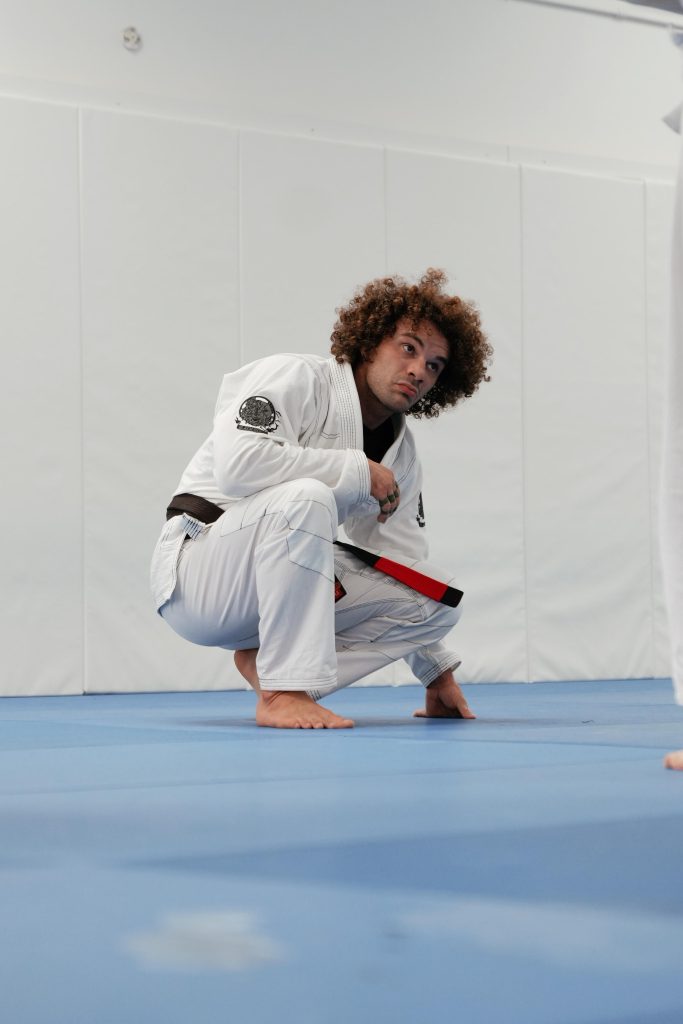
Rafael Silveira is one of the most promising young talents rising out of Atos.
The journey of Rafael Silveira Borges, one of today’s most promising names in Jiu-Jitsu, is the kind that begins long before the athlete understands his own destiny. The son of black belt Rodney Cozendey, Rafael first stepped on the mats as a child, guided playfully by his father, a game that quickly revealed itself as a calling. Today, at just 24 years old, he is a three-time world champion, five-time Brazilian champion, and owner of one of the most consistent and well-built ascensions in modern BJJ.
Coming off a nearly undefeated brown belt run and promoted to black belt by André Galvão, Rafael represents a new generation of athletes who combine refined technique, mature mindset, and unwavering professionalism. In this exclusive VFComunica interview, Rafael opens up and revisits his path: the figures who shaped him, the pains and breakthroughs, the lessons from Atos HQ, the construction of a unique style, and his vision for the future as a black belt.
Roots on the mat: a path chosen early
Rafael grew up under the direct influence of his father, who not only introduced him to Jiu-Jitsu but, in his words, chose this life for me when I was still a kid. Rodney was his first motivator and the one who pushed him early toward competition.
The next step was decisive: at just 14, Rafael moved to São José dos Campos to join the training program run by brothers Cláudio and Marco Calasans, living the Jiu-Jitsu lifestyle full time as a teenager. He remembers Calasans Jr. as the turning point of my career, someone who shaped not only his technical game but also his competitive posture.
He admits: I got inspired, I mirrored myself in him, I copied everything — from the way he fought to the calm yet aggressive behavior he had in matches.
But it was with André Galvão, leader of Atos and one of the sport’s greatest legends, that Rafael took the definitive leap. Through Calasans, he was invited to train at Atos HQ in San Diego, sharing the mat daily with world champions.
André gave me the opportunity to come to the U.S. I learned to be more professional, to live among idols, to learn from people I only saw on TV.
He highlights two figures who set the standard of effort in his mind: Galvão during ADCC camp, and Calasans Jr. in 2015.
The two people I’ve seen work the hardest in my life were André Galvão in ADCC camp and Calasans Jr. in 2015. They are legends because they were insanely dedicated.
From this trio — his father, Calasans, and Galvão — the competitive and personal DNA of Rafael Silveira emerges.
The brown belt era: pain, a controversial DQ, and building an undefeated year
Leaving his roots behind, Rafael moves to what many consider the technical peak before black belt: his brown belt phase, a period in which he lived both the lowest and highest points of his career.
The hardest moment came with the loss of his grandmother, just one month before Worlds. At the event, he was disqualified by a highly controversial decision.
I was devastated, because everything was happening at the same time.
But from that pain came his historic run:
One full year undefeated
Pan champion
World champion
Dominant performances across the circuit
And ultimately his black belt awarded by André Galvão at Worlds 2023
The transition from grief to technical peak reveals the resilience that shapes Rafael and explains why his black belt debut has generated so much anticipation.
Rafoplata: the signature weapon and the creative engine of his game
After discussing mindset, Rafael moves into the technical realm, and few athletes today have such a recognizable trademark as he does: the omoplata, affectionately dubbed Rafoplata by fans.
It all began in 2014, when he received a GracieMag issue featuring Clark Gracie after the Pan. Inspiration soon turned into experimentation.
At the IBJJF European Championship, already competing against top-level athletes like Jansen Gomes, Rafael used the omoplata to secure his first double gold.
I started discovering new methods, creating new pathways, refining details… it became my signature.
Today, the omoplata is more than a position; it is part of the technical identity that sets Rafael apart on the global stage.