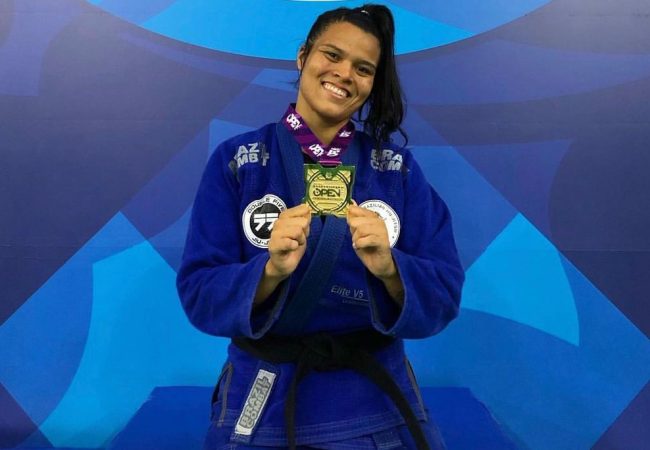


Diogo Souza is used to winning titles. Photo: Personal archive
With over two decades dedicated to Jiu-Jitsu, Diogo Souza represents a generation that has helped shape the growth of the IBJJF master divisions. At 44 years old, born in 1981, the 4th-degree black belt, who began training in 2001 and earned his black belt in 2011, remains active and competitive, standing as a clear example of longevity in the sport.
For Souza, the biggest shift from the adult division to Master 3 is not just physical, but mental.
“In the adult division, everything is very intense, very physical, and fast-paced. In the master division, experience plays a much bigger role. Today, I choose my moments better, I rely more on timing and strategy, and I focus on efficiency. It’s not about using more strength or wasting energy, it’s about understanding the right moment to push, attack, and control the match. Maturity makes your game more technical and intelligent,” he explained.
Despite the evolution in style, one goal remains unchanged across all levels of experience: the absolute division. Souza emphasizes that it continues to represent one of the purest tests in Jiu-Jitsu.
“The absolute division has a very special meaning because it tests the essence of technique. You can face heavier, stronger opponents with completely different styles. When you win that division, it shows that your technique, strategy, and mindset can overcome physical differences. Even for experienced athletes, it remains one of the most valuable achievements,” he said.
Maintaining high-level performance after the age of 40, according to Souza, requires a more complete and disciplined approach, both on and off the mats.
“After 40, performance comes much more from intelligence than just intensity. I strongly believe in balancing training, recovery, and discipline outside the mats. Sleep, nutrition, strength work, mobility, and injury prevention become just as important as technical training,” he noted.
That maturity also directly impacts competition strategy, especially when comparing weight divisions to the absolute.
“In your weight class, you usually face opponents with similar physical attributes, so strategy is more about style, grips, pace, and technical imposition. In the absolute division, adaptation is key. You have to adjust distance, timing, and risk management because you might face someone much bigger or more explosive. The approach becomes more tactical, focusing on positioning, leverage, and control,” he explained.
The continued growth of the master divisions in IBJJF events reflects a broader evolution within the sport, and athletes like Souza are at the center of that shift.
“This shows how Jiu-Jitsu has evolved into a sport of longevity. Today, we see athletes over 40 competing at a very high level, which proves that technique matures over time and modern preparation allows for a long career. Jiu-Jitsu stays with you for life,” he concluded.