
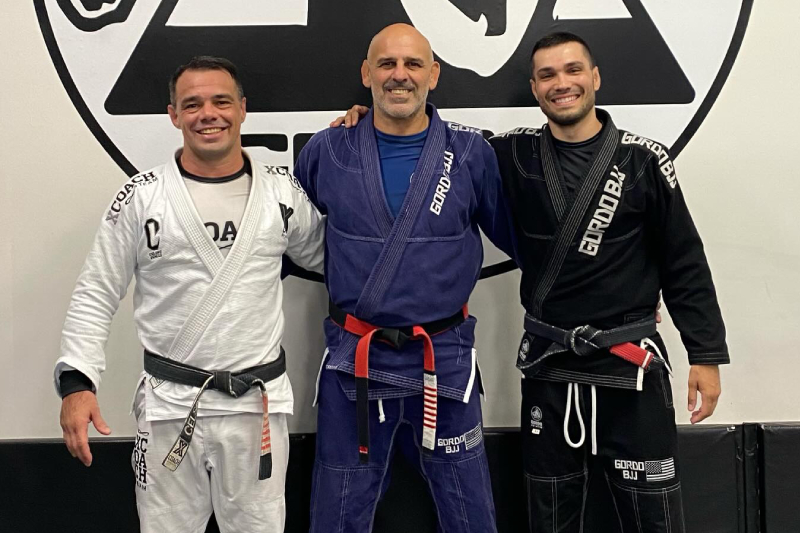
Master Roberto Gordo with Celsinho Venicius and Lucas Gripp – Photo: personal archive
Master Roberto “Gordo” and Professor Lucas Gripp recently demonstrated how the same half-guard situation can lead to different solutions based on control, the opponent’s reaction, and decision-making.
In Jiu-Jitsu, knowing a technique is only one part of the learning process. It is essential to understand the position, identify the available controls, and recognize how the opponent reacts. This idea is demonstrated through a sequence of training situations at Gordo Jiu-Jitsu in Weston, Florida.
The situations begin from a similar position: the athlete on top is facing a half-guard, while the opponent underneath is looking to control the movement and recover guard.
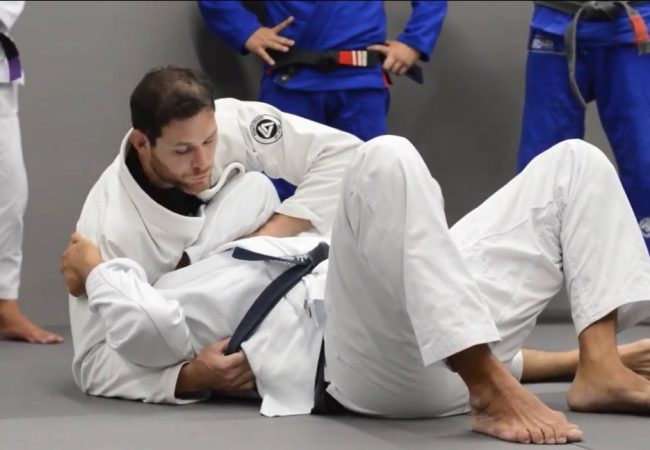
First, understanding the position. In the first moment, Gordo demonstrates the top position in half-guard with Lucas underneath. Rather than simply trying to free the trapped leg, he explains the importance of controlling the lower part of the opponent’s hip and the leg involved in the half-guard.
The idea is to create a kind of “top half-guard,” using these controls to limit the opponent’s movement and make it more difficult for them to recover a full or closed guard.
Then, Gordo uses the same principle to demonstrate a guard pass. The situation shows how a concept can be transformed into a concrete action: control the position, limit the opponent’s options, and then advance into the guard pass. For Lucas, this connection between concept and technique is fundamental to teaching. “When the student understands why they are controlling a particular area, they can adapt that knowledge to other situations.”
Ver esse post no Instagram
When the reaction changes, the solution changes too
In the following video, Lucas is on top of the half-guard while João, underneath, establishes an underhook. This reaction changes the dynamics of the position.
Instead of insisting on the same pass demonstrated earlier, Lucas identifies a new opportunity and attacks with an Ezekiel choke.
Ver esse post no Instagram
This is where one of the most important principles of Jiu-Jitsu becomes evident: the opponent’s reaction can completely change the next decision. “The position is similar, but the opponent’s reaction changes everything.
If they give us a different control, we need to recognize the opportunity that reaction creates.” The three moments demonstrate a simple progression: understand the concept → apply the control → adapt to the reaction.
For Lucas, this ability to read the position is what transforms technical knowledge into actual Jiu-Jitsu. “The more you understand Jiu-Jitsu, the less you think only about isolated techniques. You begin to see the relationships between positions. One reaction creates an opportunity, and that opportunity leads to a new decision.”
On the mat, more important than memorizing movements is understanding why they work—and knowing when to change direction when the opponent changes the problem.