
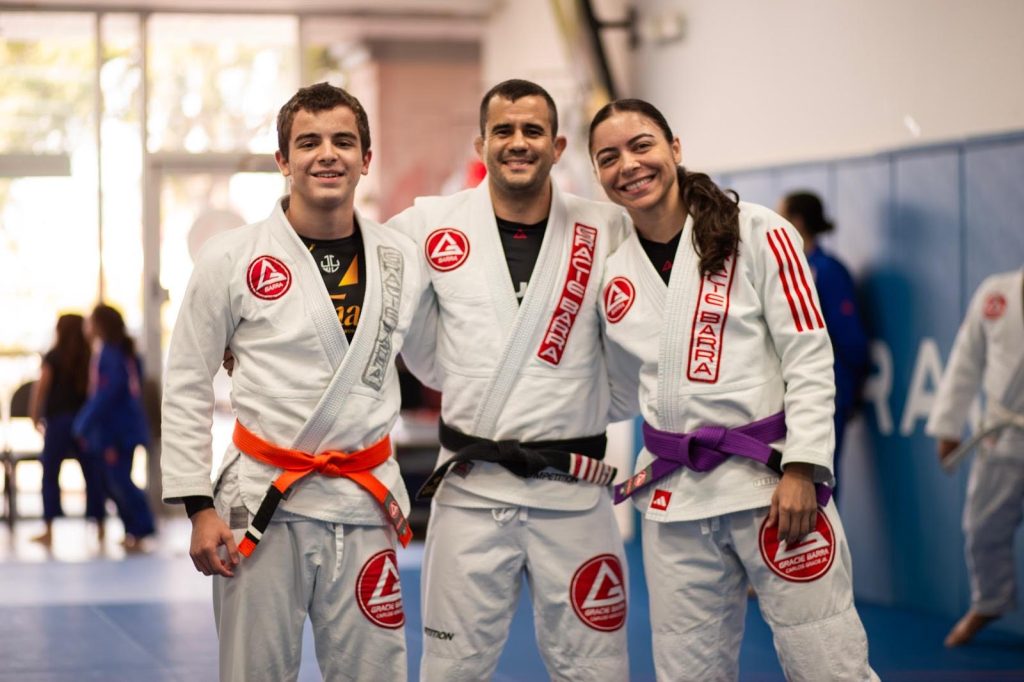
Professor Ivan Rocha among Gregor and his wife Camila Almeida. Photo: Personal Files
Is it the winning team that makes a gold medalist athlete, or are the young champions the ones who forge a winning team?
Black belt and leader of GB in Tampa, Florida, champion Ivan Rocha has reaped the rewards of persistent work and an intelligent training philosophy that seeks to motivate young athletes without harmful pressure.
In recent months, the professor known as Cabecinha has seen his son and his purple belt wife win Pan-American gold.
His son, young Gregor Rocha, won the Pan Kids. Instructor Camila Almeida became Pan-American champion while still a blue belt.
In a conversation with the GRACIEMAG.com team, the experienced Ivan reflected on the paths and pitfalls that young competitors face, and gave essential lessons on motivation, parental support, and training philosophy. To learn more, follow @GBtampa.citruspark on Instagram.
GRACIEMAG: What mistakes do parents and teachers often make at the beginning of a young champion’s journey?
IVAN “CABECINHA” ROCHA: When the dream of creating a champion becomes greater than the child’s development, the consequence can be the loss of the joy of training. This happens for various reasons, but the biggest enemy of young athletes is excessive pressure. It’s that forcing of the issue that only brings emotional pressure and harms the child and everyone around them.
Are there other mistakes?
Yes, several. Another very common mistake in Jiu-Jitsu and other sports is constantly comparing their child to other athletes. They forget that each child has their own pace of development. Parents have a fundamental role in support, encouragement, and example – it’s necessary to be aware that champions are built with patience, discipline, and love for what they do, not just with the pursuit of medals and titles. I’ve seen many talents give up not for lack of skill, but for excessive pressure. The role of parents is not to be a coach, referee, or enforcer. It’s to be the child’s safe haven.
In your experience, how can family become a truly safe haven?
When a child knows they will be supported regardless of the outcome, they develop confidence and have a much greater chance of reaching their true potential. I made many mistakes in this process with my son, Gregor. As a father and teacher at the same time, it was often difficult to separate these two roles. At times, the coach’s demands ended up overshadowing the father’s perspective.
How did you correct this in yourself?
It’s all about time and wisdom, that ability to see that things aren’t working and correct course. I gradually learned that my son needed my support and understanding more than my demands. It was a learning process for me too. Little by little, I’ve been seeking this balance, understanding that the formation of an athlete is important, but the formation of a happy and confident human being is even more valuable. Finding this balance has been a constant learning process.
What was your attitude when you called him up for tournaments?
Well, I never forced him to compete. The decision to participate in championships was always his, and I always respected his choices. What I told him, since he was little, was that I would really like to see him become a black belt in Jiu-Jitsu one day. And not because of medals or titles, but because I know the transformative impact that Jiu-Jitsu has on people’s lives. After more than 25 years living this sport, I know that the true value of Jiu-Jitsu goes far beyond competitions. It teaches discipline, respect, perseverance, humility, and confidence. My greatest desire has never been just to create a champion on the mat, but to help shape a man prepared for life’s challenges.
How did you manage to keep the fun side of the competition?
Balancing fun and results is one of the biggest challenges for any family involved in competitive sports. Gregor is 15 years old now, he trains and competes at a high level, so naturally there are responsibilities, goals, and sacrifices. But I always tried to remember that, before being an athlete, he’s a teenager. There are times when he needs to give up outings, parties, or being with friends to train or compete. It’s part of the choice for those seeking great results. At the same time, I believe he needs to live the normal experiences of his age, create memories, have fun, and enjoy his youth.
So it’s all a matter of communication. Dialogue and eye contact, always. Like anything else in life, actually.
Exactly, the balance happens through dialogue – between father and children, between students and teachers. Not everything can be training and competition, just as not everything can be fun. We try to organize the routine so that he can pursue his goals on the mats without losing his adolescence, you know?
And what do you say to Gregor and other young students so that they understand all this?
I often repeat that results cannot define the happiness of a young athlete. If he wins, great. If he loses, life goes on. Sport needs to be a tool for growth and not a source of harmful pressure. When this balance exists, the athlete can evolve, compete at a high level and, at the same time, enjoy the journey.
Ivan, how do you motivate your son after a potentially bad result?
My first reaction is to remind my son that his worth isn’t tied to a medal or the outcome of a competition. In sports, winning and losing are part of the growth process. Whenever a championship ends, regardless of the result, our first message to him is: “It’s okay. Keep your head up. We love you very much. We’re a team, and winning or losing, we’ll always be together.” The child needs to feel that the love and support of the family don’t depend on the result they had that day. I also try to show him how proud I am, but not because of the medals.
What are you most proud of about Gregor today?
My greatest pride is seeing the human being he is becoming. Seeing his character, his discipline, his humility, his courage, and the way he treats people. That’s worth much more than any title. As a father, that’s the greatest reward I can receive. Afterwards, we talk about what we learned from that experience. We analyze together what went well and what can be improved. And the message is always the same: let’s train together, let’s evolve together, and let’s prepare for the next opportunity. I always say that the true champion isn’t the one who never loses. The true champion is the one who never gives up and is always striving to improve, whether in competitions, training, or personal life. That’s what I try to teach him every day.
And you have your own medals and mementos to help him with that, right?
Exactly. Because, in the end, the medals are kept in a box, but the values that sport teaches last a lifetime. We strive for him to have a champion’s mindset. If that’s what he truly wants for his life, then he needs to stay strong, with discipline, focus, and an ever-growing desire to improve.
How do you measure the progress of your students?
It’s something much broader than just the color of the medal. Winning championships is great, it’s important, it’s the goal of any athlete who competes at a high level, and there’s nothing wrong with wanting to win. But we emphasize that the most important thing is not to forget the incredible human being they are becoming, and will continue to become. Because true progress isn’t just in the result, but in how they grow as a person. Having a champion’s mindset means continuing to improve every day, even after victories or defeats. It’s about learning, adjusting, persisting, and never giving up. That’s what we try to build in them: a strong mentality on the mat and an even better person outside the gym.
What were your assessments of his performance at the Pan Kids, in the two fights he had?
The Pan Kids is always a special experience because it brings together the best young athletes in the world and demands not only technique but also emotional maturity. In this edition, he had two very solid fights. In the first match, he was winning 8-0 and managed to finish with great control and precision. In the final, he won 5-0, also with a consistent performance from start to finish, maintaining total control of the fight. A detail is that in both fights, he didn’t concede any points or advantages, which shows the level of dominance and confidence he displayed during the competition. It was incredible; after all, he fought intelligently and strategically, forcing his opponents into his game. He managed to dictate the pace and impose his style, something that has been extensively trained and built over time. More than the victories, what caught my attention was this technical and mental mastery. Overall, it was a productive competition. The result came, but the most important thing was how he competed: with intelligence, control, and maturity. This shows that all the work has been well done and confirms that he is on the right track.