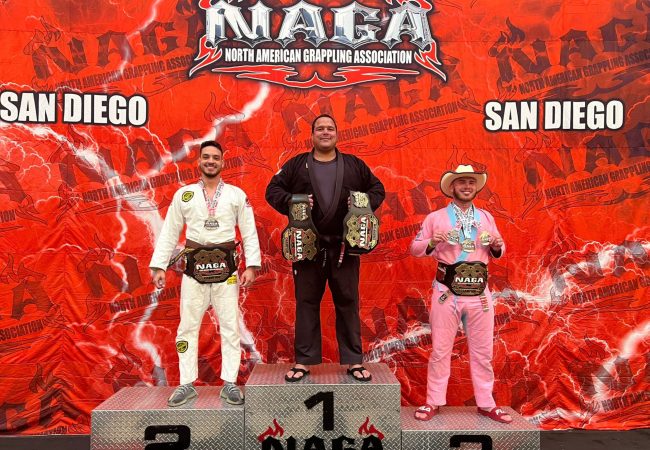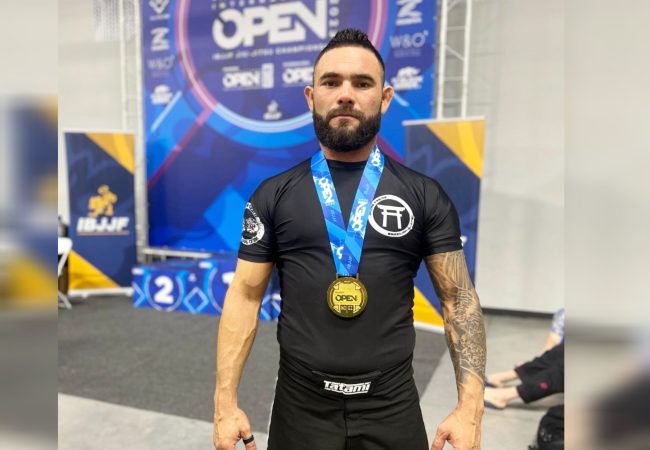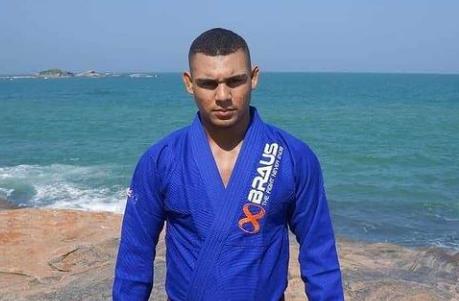

Every martial artist has a beginning, a spark that ignites a lifelong journey. For Juan Carlos Lopez, that spark came as a teenager in Ecuador, when a simple triangle choke on an MMA video set him on a path that would eventually lead to the highest levels of Jiu-Jitsu.
From those first steps on the mat, guided by his brother Carlos and a circle of dedicated coaches, Lopez embraced the philosophy that has carried him through every stage of his career: never stop learning.
Today, Lopez’s life revolves around training, recovery, and the pursuit of excellence. His daily routine reflects the discipline of a professional athlete, balancing intense sessions with the wisdom of rest and study.
Lopez sees Jiu-Jitsu as more than a sport; it is a community builder, a force that unites people of all ages and backgrounds. His vision of an academy is not just a place to train, but a support system where friendships are forged and collective success is celebrated.
In this interview, he shares the lessons, challenges, and motivations that continue to shape his path, offering inspiration to anyone who steps onto the mat in search of growth.
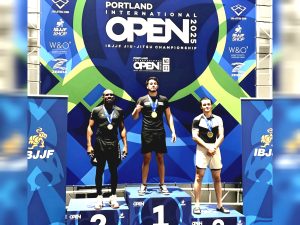
GRACIEMAG: Every great tree has deep roots. How did you start in Jiu-Jitsu?
JUAN CARLOS LOPEZ: I started Jiu-Jitsu when I was 13 years old, in Ecuador. My brother Carlos showed me a video of an MMA fight where a guy finished the fight with a triangle. I thought it was really cool, and the next day my dad took us to train at a friend’s gym. The rest is history. The coaches who have guided me the most throughout my journey are my brother, Carlos Lopez, Alberto Marmol, Fernando Soluço, Johnny Tama, and Johnny Faria. PJ Barch has also been extremely influential in my game over the last couple of years. The greatest lesson I have learned from all of them is to never stop learning. No matter how much experience you have, you should never think you know everything. There is always something new to learn, improve, and understand.
What does your daily planning look?
Training is fundamental to my life. I usually train Monday through Saturday, often twice a day. Depending on the day, that can be a Jiu-Jitsu session and wrestling, Jiu-Jitsu and lifting, or sometimes two Jiu-Jitsu sessions. At the same time, I have learned that recovery is just as important as training hard. Having slower and easier days allows my body to recover and also helps me look at my Jiu-Jitsu from a different perspective. You don’t always have to train as hard as possible to improve. Studying and drilling are also a huge part of my development, along with getting enough rest. Outside of Jiu-Jitsu, I like playing tennis, golfing, or simply going to the beach and resetting. Those things help me keep a clear mind and avoid burnout.
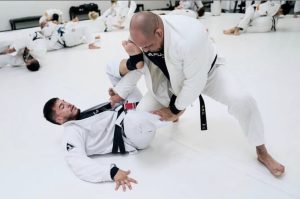
What are the main benefits that a Jiu-Jitsu professor brings to the community where he works?
I believe Jiu-Jitsu professors have the opportunity to impact so many people’s lives. It doesn’t matter if they are adults, kids, teenagers, men, or women, Jiu-Jitsu can bring people together. One of the greatest things about teaching is getting to know new people, making friendships, and building a strong community where everyone wants to see each other succeed. A good Jiu-Jitsu academy becomes more than just a place to train; it becomes a community and a support system.
What were the biggest challenges and main achievements you’ve had in your competitive career, and what lessons did you take from them?
Winning IBJJF medals was always a dream of mine. I didn’t compete in an IBJJF tournament until I was a purple belt. I competed a few times as a brown belt but was never able to win a gold medal. After moving to the United States, I started competing much more frequently and was able to win multiple gold medals. So, I can say that I accomplished one of my goals of becoming successful at the black belt level. But I still have much bigger goals. My biggest goals are to become a world champion, compete at ADCC, represent my country, and prove to myself that I can compete at the highest level of Jiu-Jitsu.
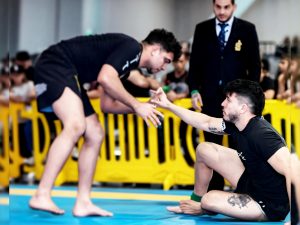
What is the secret to turning an average fighter into a great champion?
Discipline and consistency are the two biggest things. Anyone can train when they are motivated, but very few people continue training when things are difficult. Champions are the people who stick to the calendar, show up even when they don’t feel like it, and remain consistent and disciplined both in the sport and in their everyday lives. Talent can take you far, but consistency is what allows you to keep improving.
What motivational phrase do you like to repeat to yourself when going through a difficult moment in your career?
I remind myself how badly I wanted this life and how hard I worked to make it happen. I remind myself that I am living my dream. When things get difficult, I just keep moving forward. Going backward is not an option. I try to stay focused and sharp, knowing that every bad moment eventually passes. No matter what happens, you have to keep moving forward.
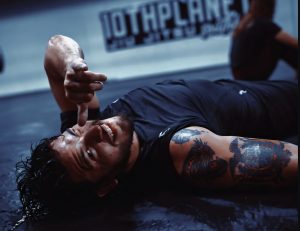
What advice do you usually give to those who dream of making a living from Jiu-Jitsu?
Be true to yourself and work hard. But I also think you have to be smart. Learn how to communicate, learn how to teach, and most importantly, learn how to treat people. In my opinion, that is one of the most important parts of building a career in Jiu-Jitsu. Nobody cares how good you are if you are a bad person. People want to be around people who are kind, well-mannered, respectful, and genuine. Learn as much as you can, compete, challenge yourself, and prove to yourself that you are capable of achieving whatever you set your mind to.
What are your plans for the future? What level do you aim to reach, and how do you envision the path to get there?
My plans for the future are to keep my body healthy, continue competing at the highest level, keep learning, and travel the world doing what I love. I also want to build a family one day, to have kids and a beautiful wife, and hopefully share the mats with them. That would be an amazing part of my life. Eventually, I would love to open my own school, build an amazing Jiu-Jitsu community, and continue spreading the knowledge that was passed down to me. I want to keep learning, teaching, and sharing Jiu-Jitsu for the rest of my life.